
Past-Future, Present-Future, Future-Future: Hilma af Klint in Three Temporal Dimensions
paper given at the 2023 Modernist Futures conference, hosted by Modernist Studies in Asia

I’ve been thinking a lot, per usual, about the history of art history. While reading Dore Bowen’s essay recently, “With One Eye on the Wild: Michael Ann Holly and The Wolf of Gubbio,” she spoke of Holly’s fascination with “those twentieth-century European figures who, at odds with prevailing tendencies of their era, renovated our understanding of how works of art function in time.” Hilma af Klint is one such artist, which brings me back to a paper I gave in 2023, “Past-Future, Present-Future, Future-Future: Hilma af Klint in Three Temporal Dimensions,” for the Modernist Futures conference, hosted by Modernist Studies in Asia. Since the paper was delivered at the conference only, I thought I’d post it here.
“Past-Future, Present-Future, Future-Future: Hilma af Klint in Three Temporal Dimensions”
In 1932, Swedish artist Hilma af Klint (1862-1944) wrote in her notebook that her [spiritual] work should not be shown for twenty years after her death. She would spend the final decades of her life preparing a spiritually complex diagrammatic language to be understood by future generations. Forty-two years would pass before her [spiritual] work was brought to the attention of an international audience for the first time in Maurice Tuchman’s exhibition The Spiritual in Art: Abstract Painting 1890-1986 (1986).
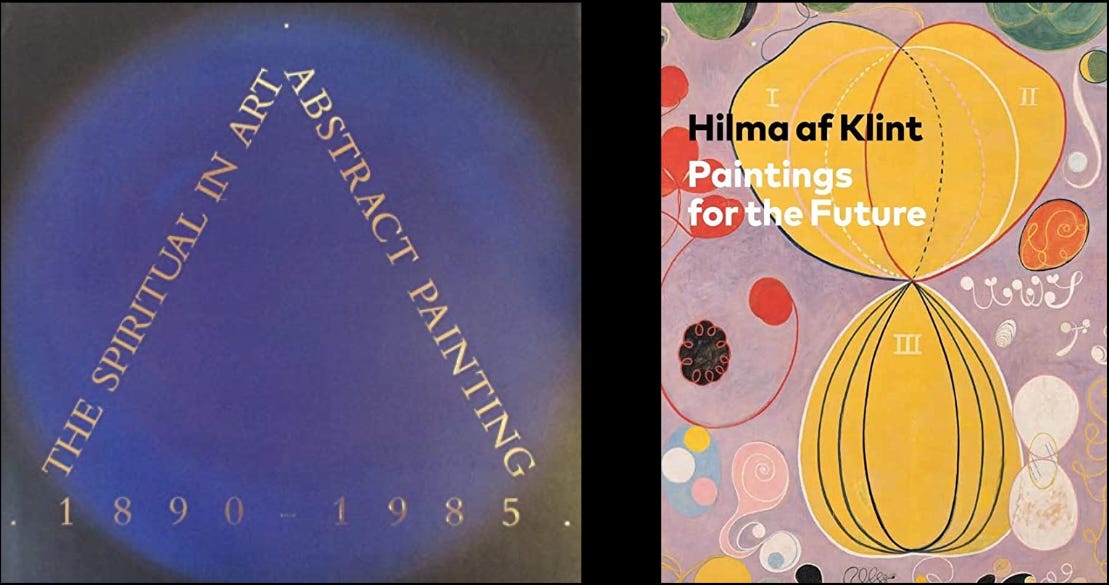
Despite the exhibition’s groundbreaking historical narrative demonstrating the inextricable link between esoteric spirituality and modern abstract painting, af Klint’s spiritual vision was not yet ready to be received. In 2018, the Solomon R. Guggenheim Museum’s record-breaking exhibition Hilma af Klint: Paintings for the Future established her future had arrived. The present-future of twenty-first century capitalism, however, is fraught with a complicated aesthetic consumption where af Klint has become a brand and her spiritual vision a commodity.
This talk critically examines two important choices made by af Klint and her family: her decision to not show her [spiritual] works until twenty years after death and her family’s prohibition against the sale of her work. These choices are not insignificant. In fact, they can be understood as acts of resistance against the contemporary consumerist impulse.
Framed and supported by philosopher Giorgio Agamben’s expansion of Gilles Deleuze’s philosophy of creation in his book Creation and Anarchy: The Work of Art and the Religion of Capitalism, or simply, “each act of creation resists something,” I explore af Klint’s and her family’s choices as acts of resistance against the consumer culture in which her work has become entrenched, and speculate on whether the art establishment’s decided future for af Klint aligns with her original vision.
Since Deleuze doesn’t define what he means by “to resist,” Agamben questions what’s left unsaid in Deleuze’s theory. With a focus on potential, Agamben explores the relationship between resistance and creation and how the action of resistance expresses itself in the act of creation. In doing so, he investigates potential: the potential-to, defined as the impersonal or creative potential of the artist and the potential-not-to or the resistance existent in the act of creation.
If we consider af Klint’s creative process and potential in Agamben’s terms – that is, the potential-to and the potential-not-to, we can begin to explore her and her family’s choices as acting and resisting at once. Now, imagine yourself in Sweden during the late nineteenth and early twentieth century, and consider af Klint’s resistance to the past-future as integral to her forward-looking vision.
In 1906, af Klint began her well-known series the Paintings for the Temple (1906-1915), a commission she accepted from a spirit guide during a séance that would comprise of 193 works drawn from her spiritual practice. This series was a departure from her academic training at The Technical School in Stockholm in 1880 and the Royal Academy of Fine Arts she attended between 1882-1887. She worked professionally as a portraitist and landscape painter after graduation. And, only a few years before serious development of the Paintings for the Temple, af Klint worked as an illustrator at the Institute of Veterinary Medicine.
In tandem, she founded the séance group The Five (De Fem) in 1896 with four other women producing 100s of automatic drawings and regularly attended meetings at the Edelweiss Society, a spiritualist organization. At this time, her decision to keep her professional and spiritual life separate, only sharing her spiritual works with a select few, demonstrates her artistic potential and her calculated resistance to sharing her spiritual vision too early.[1] By 1919, however, af Klint began to compile what scholar Julia Voss has described as “The Suitcase Museum,” which contained miniature watercolors of her spiritual works, including the Paintings for the Temple. In Hilma af Klint: A Biography, Voss uncovers af Klint’s two-decade long attempt at finding a public space for her spiritual works. Yet, she was met with resistance and chose to preserve the works for an unknown future.
It's likely the resistance toward her work in the past-future influenced her decision to not show her work for twenty years after death with the hope they would be better understood by future generations. Af Klint states: “The experiments I have conducted…that were to awaken humanity when they were cast upon the world were pioneering endeavors. Though they travel through much dirt they will yet retain their purity.”[2] Her interest in purity suggests freedom from outside influence. She made sure to preserve the unadulterated state of her works for a time by stipulating in her notebook that her spiritual works not be shown until at least twenty years after death.[3] Her acts of creation might be understood as acts of resistance toward a public she felt not yet prepared to receive the spiritual knowledge transmitted through her work, and perhaps resistance to the increasingly materialistic world developing at the turn of the century.
We’re confronted with a very present and complicated dialectic in af Klint’s act of creation that is supported by Agamben’s two-fold structure of potential, a term he defines as “an ambiguous being that not only is capable of something and of its opposite, but contains in itself an intimate and irreducible resistance.”[4] The impersonal or potential-to points toward af Klint’s ability to exercise creative expression and the potential-not-to highlights her reticence and resistance to further attempts at sharing her spiritual work during her time. Her resistance in action demonstrates remarkable restraint and the importance of preserving the work’s potential for future generations.
The relationship between potential-to and potential-not-to thus far is as follows: Af Klint acted in 1906 by accepting the commission from one of her spirit guides [Amaliel]; She acted in 1919 by developing the “suitcase museum” to engage a broader public; She resisted showing her spiritual works, stipulating in her notebook in 1932 they not be shown until at least twenty years after death. To echo Agamben: “Mastery preserves and exercises in action not its potential to play but its potential not to play.”[5] Af Klint’s decision not to play and preserve her paintings for an uncertain future after decades of concentrated effort in the careful production of esoteric art is a testament to action as resistance.
As we now arrive in the present-future, it’s important to note that af Klint likely anticipated a future of seekers prepared for understanding the synthesis of spiritual and scientific ideas present in her work as mechanisms to teach us something about the world and ourselves. Permeated with cosmological, scientific, and geometric motifs, her recurrent use of the spiral, in particular, suggests her interest in evolution as equilibrium. She certainly imagined a world beyond division and hierarchy where humankind is capable of transcendence from earthly to higher spheres. Yet, the present-future in which the artworld established her anticipated future has arrived is all too earthbound.
In the fall of 2017, artists, curators, and art historians convened in Brooklyn, New York to address the work of af Klint and her status as a pioneer of abstraction, a conversation that continues today in myriad configurations. Moderated by Curator of Contemporary Art Helen Molesworth, one question stands out: “How has af Klint’s refusal to show her work until twenty years after she died, along with the prohibition against selling the work, affected our ability to narrativize her historically?”[6] This certainly isn’t an obscure question considering commercialization of an artist’s work plays a role in determining artistic relevancy, authenticity, market value, and the depth of their cultural and intellectual influence.[7]
In 2018, the Guggenheim Museum opened the exhibition Hilma af Klint: Paintings for the Future, a curious title in its finite infinitude assuring us that af Klint’s work still awaits an unknown future. Yet, then and now, academic and mainstream articles alike ooze futurist phrases asserting the present moment as the future she anticipated.[8] It was af Klint’s wish that The Paintings for the Temple occupy a spiral temple. Frank Lloyd Wright’s Guggenheim Museum meets that criterion, as it is known for its distinctive spiral form. I wonder, though: Has af Klint’s anticipated future been reduced to the present-future’s needs?
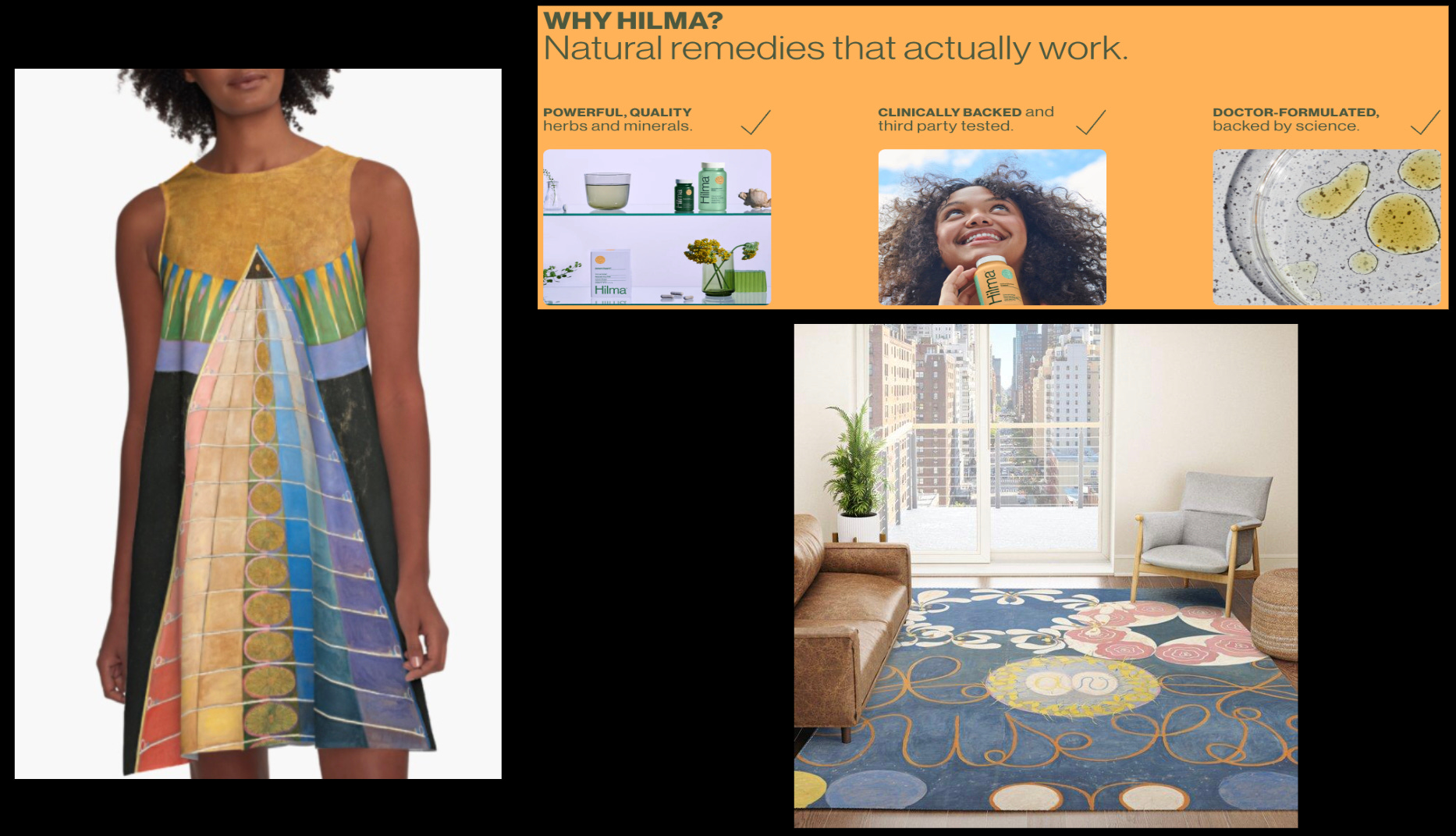
Since the exhibition, companies have adapted af Klint’s aesthetics, even her name, in order to promote their brands. Hilma natural remedies is an herbal medicine brand whose founders took inspiration from af Klint’s engagement with the natural world.

To take the direct-to-consumer market further, mindfulness collective 3rd Ritual’s logo appropriates af Klint’s visual lexicon and applies her soft color palette to promote their apothecary toolkit.[9]
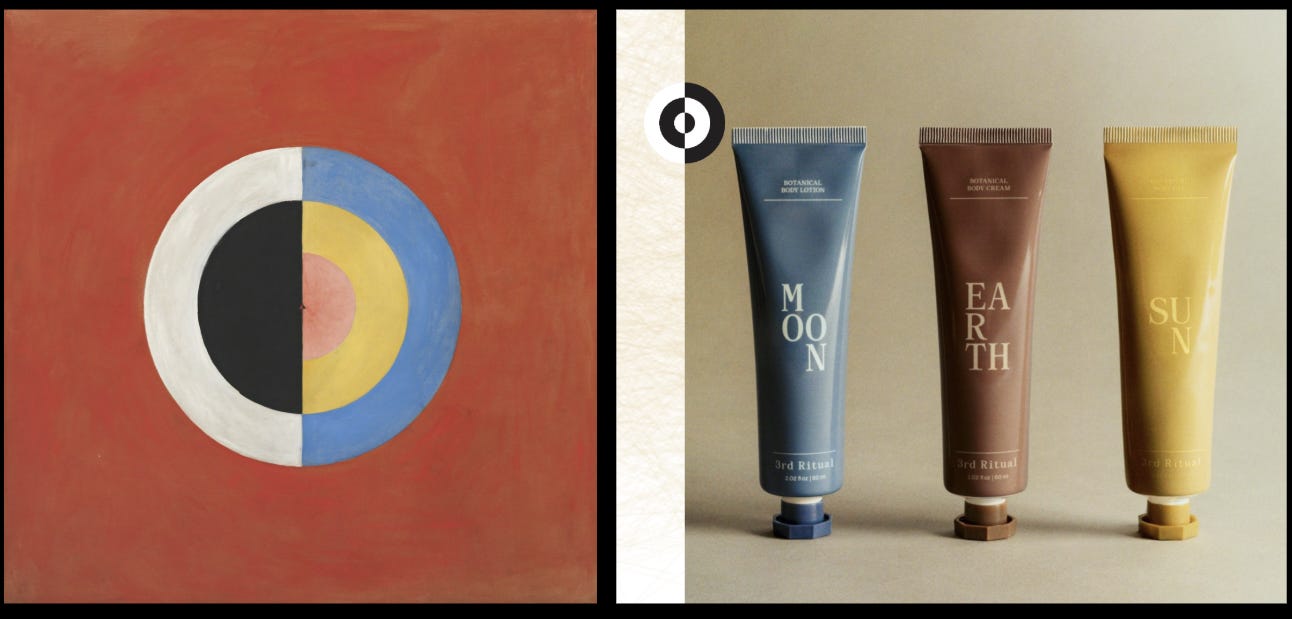
Af Klint’s spiritually significant symbology is reduced to merely ‘good design,’ as we see in the absence of her principal colors yellow (male) and blue (female) in their logo of concentric circles or the removal of the segmented triangle in the center that unites the dualities of light and dark and male and female, signifying af Klint’s interest in a higher unity. Although 3rd Ritual’s mission statement highlights the importance of connection, their participation in breaking images places them in the category of “innocent vandals,” the language of Bruno Latour to describe those “who destroy not so much out of a hatred of images, but out of ignorance, a lust for profit.”[10] Although the direct-to-consumer industry takes inspiration from af Klint’s aesthetic, it’s in fact a radical departure from her vision. As Voss states: “Hilma saw it her task to give form to new ideas and to ensure that others knew about them.” Manipulating af Klint’s symbology weakens her message and becomes the entrepreneur’s subject myth. It’s not my intention, however, to criticize but rather highlight the artist’s and her family’s acts of resistance to such materialist tokens.
Most recently, some of her family’s acts of resistance were tested when on November 14, 2022, The Gallery of Digital Assets (GODA) led by “some of the biggest names in consumer, art, music, NFT, and fashion,” such as recording artist Pharrell Williams, made available at auction NFTs (non-fungible tokens) based on af Klint’s series the Paintings for the Temple.[11] Considering the prohibition against the sale and commercialization of af Klint’s physical works, NFTs are a way for third party companies to take what’s in the public domain, repurpose, and sell.
Writer Aliya Say spoke with former af Klint Foundation chair Johan af Klint and his niece Hedvig Ersman for a recent article published in “The Art Newspaper.” The article states: “The descendants point out, Hilma af Klint did not want her creations to be commercialised…moreover, af Klint intended for the Paintings for the Temple series to be kept and displayed together as one meta-project: a project for connecting with the divine.” The family points out af Klint’s resistance as well as their own resistance to the present-future of globalized consumer culture.
Ersman states further in a Twitter thread on November 9, 2022: “Commercializing af Klint’s abstract art contradicts her intensions with her art. She actively CHOSE not to put them on the commercial market, she did NOT intend them to be commercial “assets.” What is happening now is in opposition with her intensions.” It seems af Klint has encountered philosopher Guy Debord’s spectacle, where the spiritual knowledge to be gleaned in her work to unite humanity has become an ‘estranged representation.’ Is her spiritual message to humanity somewhat broken by the cult of capitalism?
If we circle back to Agamben and his ideas on creation as an act of resistance, along with his thoughts on ‘potential,’ or rather the ‘potential-not-to,’ he asserts a claim that supports af Klint’s creative action:
If creation were only potential-to-, which cannot but blindly cross into the act, art would lapse into execution, which proceeds with false confidence toward a complete form, since it has removed the resistance of the potential-not-to. Contrary to a common equivocation, mastery is not formal perfection but quite the opposite: it is the preservation of potential in the act, the salvation of the imperfection in the perfect form.[13]
Af Klint was demonstrating her potential-to insofar as she was exercising her creative potential in her time. Yet, her creative process also highlights her potential-not-to when she decided it best not to show her spiritual works for twenty years after death, preserving the works’ potential for future generations by choosing the potential-not-to. The same applies to her family’s decision to prohibit the sale of af Klint’s works in any given future, an act of resistance that attempts to avoid reducing her paintings to materialist tokens and luxury commodities.
Af Klint’s resistance preserved the work from a past-future not yet prepared to receive her message. Her family’s resistance to monetize is an attempt at protecting the work from becoming mere commodity. Thus, to choose the potential-not-to is an act of resistance to preserve the works’ potential for a still unknown future. This resistance in action privileges af Klint’s work as spiritual epistemology — visual resources that transcend modern constructs of time and the capitalist machine. This resistance also suggests the present-future of twenty first-century capitalism is not quite in alignment with af Klint’s vision.
Af Klint’s work serves to bring forth a transformation in us, operating as a continuum, a space that prepares viewers for their evolution through stages and cycles of rebirth. Evolution of consciousness and human perception are major themes throughout her work. She explores evolution as an incomplete and always forming process of spiritual development. Yet, as both historically determined object and consumer product, historicization and the commodity culture of capitalism tend to reduce the infinite potential of af Klint’s work to something finite, something complete. In this way, I posit her future has not yet arrived — and perhaps it never will — until we acknowledge that duplication and mass production of her work breaks the image and, worse, concludes it.
We should be grateful to have received such an immersive space for contemplation, where deeper engagement can help us envision a new world, a future in which we too choose resistance. Perhaps this future is the one af Klint is waiting for: a future where her work is received as a form of resistance to materialist tokens and opens a path for spiritual renewal, where science and religio-philosophical syncretism are recognized as visual methods designed to teach us something about ourselves and the world. I’ve for years been skeptical of the art establishment’s decided future for af Klint, not convinced it’s in alignment with her vision.
In order to continue and muse on possible futures, it seems apt to end with a couple open questions rather than a conclusion:
Has the consumerist impulse blinded us from seeing the future she anticipated?
Have we missed the importance of the choices she and her family have made within the world of capitalism, and how those choices are, in fact, acts of resistance against consumerism?
[1] Certainly there's social factors involved, such as women’s role in society and the oft demonizing perception of their psychological state as mediums.
[2] Quoted in Anna Maria Svensson, “The Greatness of Things: The Art of Hilma af Klint,” in Hilma af Klint, ed. John Hutchinson, exh. cat (Dublin: Douglas Hyde Gallery, 2005), p. 17.
[3] This stipulation can be found in archival notebook Hak_1049 held at the Hilma af Klint Foundation in Sweden.
[4] Agamben, Creation and Anarchy: The Work of Art and the Religion of Capitalism (Stanford: Stanford University Press, 2029), 18-19.
[5] Ibid., 19.
[6] Hilma af Klint: Paintings for the Future (New York: Guggenheim Museum Publications, 2018).
[7] This article in Hyperallergic also questions whether 2018 was af Klint’s future, problematizing institutionally approved narratives: https://hyperallergic.com/472426/hilma-af-klint-paintings-for-the-future-solomon-r-guggenheim-museum/
[8] “The Future Belonged to af Klint,” Vulture article: https://www.vulture.com/2018/09/hilma-af-klint-paintings-for-the-future-at-guggenheim.html; “the future has now arrived” https://www.smh.com.au/culture/art-and-design/record-breaking-show-arrives-in-sydney-and-reveals-a-woman-ahead-of-her-time-20210610-p5801j.html; etcetera.
[9] What you see in the af Klint work on the left is a segmented circle with light and dark on the left side and male (yellow) and female (blue) on the right. The triangle in the center also segmented unites these dualities and signifies her interest in a higher unity.
[10] Latour, On the Modern Cult of the Factish Gods (Durham: Duke University Press, 2010), 87-88.
[11] VR experiences inviting visitors to explore an af Klint–simulated spiritual world, and an AR app featuring eighteen of af Klint’s paintings, allowing users to place her works along a path in Regent’s Park in London, are just a few examples. Wellness brands are also engaging with her legacy in new ways. NFTs, which are digital identifiers that cannot be copied, are recorded on the blockchain and certify the authenticity and ownership of a digital file across various media.
[12] Article info; Hilma af Klint’s family criticises the NFT sale of the artist’s sacred paintings
[13] Agamben, 20.